January 27th–
AI Assignment
1) Reflect on the essay and image created as well as discussion of AI art and essay generation as a whole:
The AI platform I chose to you was Microsoft Copilot. The prompt I gave it was “write a 2-page essay about the Titanic and provide a picture”. First, it developed the picture.
This is the picture I received:
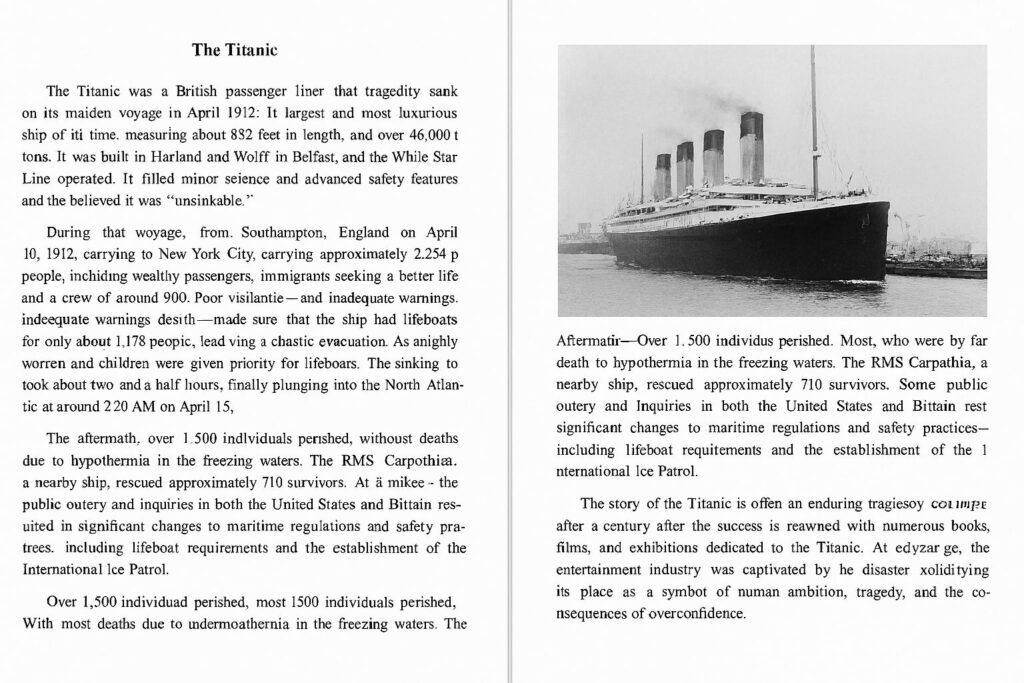
I think it got confused when I asked a multi-tasked prompt so in the picture it combined both of what I was asking for. The writing within this picture has many misspelled words and weird phrasing. Also to compare the small photo it provided of the Titanic ship I did a quick Google search to compare.
Below is the picture I found off of Getty Images:
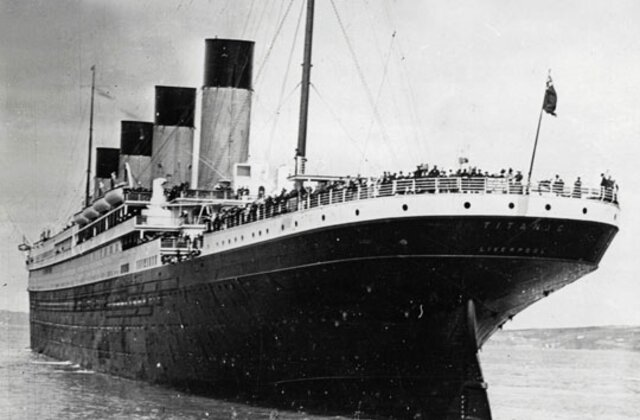
Both the AI and Getty Image photo are similar but the AI one had a few added or disheveled aspects in the photo. For example, you can see on the funnels in Getty Image photo the black at the top is very crisp and clear. On the AI image the black is seen to be pretty messy and not as crisp of a line. At the bow of the ship there is a flag on a pole, the AI image is missing it. In the AI image it seems like they added a 3rd layer demonstrated with the white metal located right under the funnels. Additionally, in the AI image the life boats are barely seen, basically creating weird shapes trying to create what it through the boats looked like.
Then it provided the essay:
“Here’s a full, polished two‑page essay to go with it—written in a clear, academic style and roughly the length of a standard double‑spaced two‑page paper.
The Titanic: Ambition, Tragedy, and Legacy
The sinking of the RMS Titanic remains one of the most haunting and culturally enduring disasters of the twentieth century. Launched in 1912, the Titanic was celebrated as the pinnacle of maritime engineering—a vessel so technologically advanced and so massive in scale that many believed it to be practically unsinkable. Built by Harland and Wolff in Belfast for the White Star Line, the ship stretched approximately 882 feet long and weighed over 46,000 tons. It featured opulent accommodations for first‑class passengers, including grand dining rooms, ornate staircases, and luxurious suites, while also carrying thousands of immigrants seeking new lives in America. When the Titanic departed Southampton on April 10, 1912, bound for New York City, it carried more than 2,200 passengers and crew, each with their own hopes, expectations, and stories. Few could have imagined that the voyage would end in catastrophe.
The events leading to the disaster unfolded on the night of April 14, 1912, when the Titanic steamed through the North Atlantic at high speed despite multiple iceberg warnings from nearby ships. The sea was unusually calm, making icebergs harder to spot due to the lack of waves breaking against them. At approximately 11:40 PM, lookouts Frederick Fleet and Reginald Lee spotted a looming iceberg directly in the ship’s path. Although the crew attempted to steer away, the iceberg scraped along the starboard side, rupturing several of the ship’s supposedly watertight compartments. The damage proved fatal: the Titanic was designed to stay afloat with four flooded compartments, but the iceberg had compromised at least five. As water poured in, the bow began to sink, setting off a chain of events that would expose the ship’s most critical flaw—its insufficient number of lifeboats.
The evacuation that followed was chaotic and deeply flawed. The Titanic carried only enough lifeboats for about half the people on board, a decision based on outdated maritime regulations and the belief that the ship itself was the best lifeboat. Officers prioritized women and children, but confusion, fear, and disbelief led to many lifeboats being launched partially empty. As the bow sank deeper, the stern lifted dramatically out of the water, eventually breaking off as the ship plunged beneath the surface at around 2:20 AM on April 15. More than 1,500 people died, most from hypothermia in the frigid Atlantic. Only about 710 survivors were rescued by the RMS Carpathia, which arrived nearly two hours after the ship disappeared beneath the waves.
In the aftermath, the world reacted with shock and outrage. Investigations in both the United States and the United Kingdom revealed a series of preventable failures: excessive speed, inadequate lifeboat capacity, and insufficient emergency preparedness. These inquiries led to sweeping reforms in maritime safety. New regulations required ships to carry enough lifeboats for all passengers, conduct regular lifeboat drills, maintain 24‑hour radio communication, and adhere to safer routes during iceberg season. The International Ice Patrol was established to monitor iceberg activity and prevent similar tragedies. In this way, the Titanic’s loss directly reshaped global maritime practices.
More than a century later, the Titanic continues to captivate the public imagination. Its story has inspired countless books, documentaries, museum exhibitions, and one of the most successful films in cinematic history. The ship has become a symbol of human ambition—both its triumphs and its blind spots. It represents the tension between technological progress and humility, reminding us that even the most advanced creations are vulnerable to nature’s power. The Titanic endures not simply because of the scale of the tragedy, but because it reflects universal themes: hope, hubris, courage, and loss. Its legacy is a testament to the lives affected and a reminder of the importance of learning from the past.”
Overall, I think the essay that the AI produced read pretty well. Though many of the claims didn’t have any reference to back the “facts” up so I wanted to fact-check the essay. I went to another source, EXA Hallucinations Detector, and pasted the essay to check with real web data. In result, most of the facts stated in the essay were proven as true though it did detect a few outliers.
This is what the results from the AI fact checker looked like (it provided sources and an explanation as to why the statement was incorrect) :
“The Titanic carried thousands of immigrants seeking new lives in America.”
❌Refuted 95% Confident
The Titanic carried immigrants, but not thousands – according to Source 3, there were approximately 408 immigrants in third class from various countries, and Source 1 states that of the 2,223 people aboard, only 709 were third-class passengers, most of whom were immigrants.
Sources
- https://www.archives.gov/publications/prologue/2012/spring/titanic.html
- https://www.peggywirgau.com/recent-posts/2017/02/02/immigrants-on-the-titanic
- https://www.dummies.com/article/academics-the-arts/history/20th-century/how-the-titanic-passengers-personified-the-immigrant-story-180777/“
2) Explore how well the platform you chose was able to transcribe the handwritten page:
From the Fredericksburg National Cemetery, I asked Google Gemini to transcribe a page.
The prompt I gave it was:
“Transcribe this page”
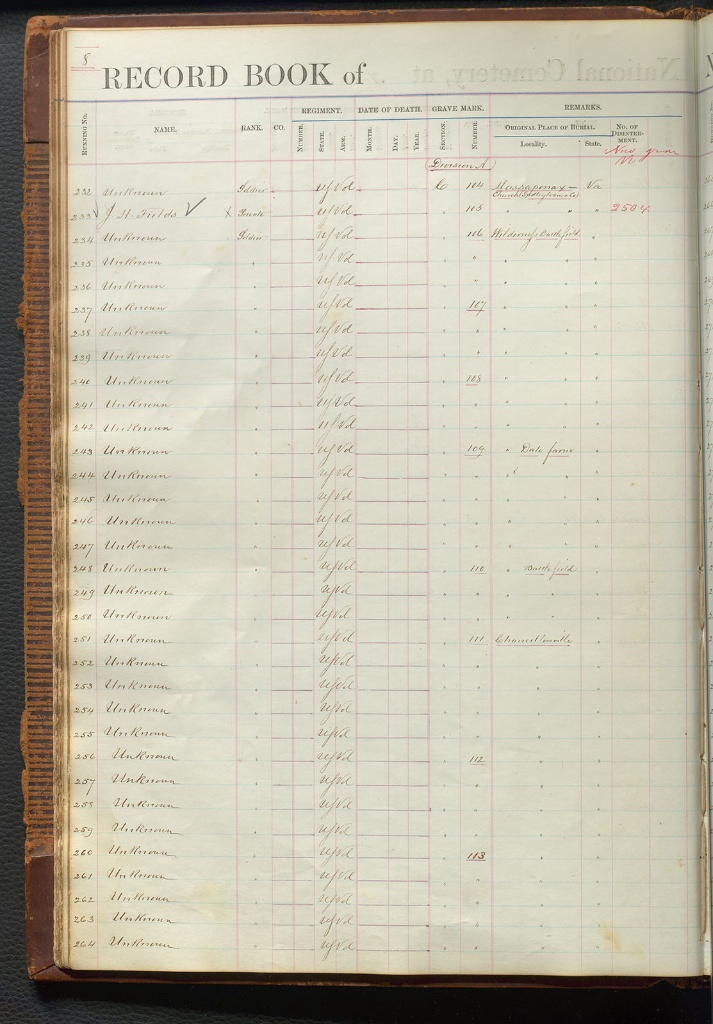
It responding with:
“This image is a page from a National Cemetery Record Book, documenting the burials of soldiers, most of whom are unidentified. The page is organized into columns for identification, military service, and burial location.
Below is the transcription of the ledger page.
Record Book: Division A
| Running No. | Name | Rank | Co. | Regiment (State) | Grave Mark (Section) | Grave Mark (Number) | Original Place of Burial (Locality) | Original Place of Burial (State) | Remarks |
| 232 | Unknown | Soldier | U.S. Vol. | 6 | 104 | Massaponax Church (Spotsylvania Co) | Va. | ||
| 233 | J. H. Fields | Private | U.S. Vol. | “ | 105 | “ | “ | 2504 | |
| 234 | Unknown | Soldier | U.S. Vol. | “ | 106 | Wilderness Battlefield | “ | ||
| 235 | Unknown | “ | U.S. Vol. | “ | “ | “ | “ | ||
| 236 | Unknown | “ | U.S. Vol. | “ | “ | “ | “ | ||
| 237 | Unknown | “ | U.S. Vol. | “ | 107 | “ | “ | ||
| 238 | Unknown | “ | U.S. Vol. | “ | “ | “ | “ | ||
| 239 | Unknown | “ | U.S. Vol. | “ | “ | “ | “ | ||
| 240 | Unknown | “ | U.S. Vol. | “ | 108 | “ | “ | ||
| 241 | Unknown | “ | U.S. Vol. | “ | “ | “ | “ | ||
| 242 | Unknown | “ | U.S. Vol. | “ | “ | “ | “ | ||
| 243 | Unknown | “ | U.S. Vol. | “ | 109 | Dale Farm | “ | ||
| 244 | Unknown | “ | U.S. Vol. | “ | “ | “ | “ | ||
| 245 | Unknown | “ | U.S. Vol. | “ | “ | “ | “ | ||
| 246 | Unknown | “ | U.S. Vol. | “ | “ | “ | “ | ||
| 247 | Unknown | “ | U.S. Vol. | “ | “ | “ | “ | ||
| 248 | Unknown | “ | U.S. Vol. | “ | 110 | Battlefield | “ | ||
| 249 | Unknown | “ | U.S. Vol. | “ | “ | “ | “ | ||
| 250 | Unknown | “ | U.S. Vol. | “ | “ | “ | “ | ||
| 251 | Unknown | “ | U.S. Vol. | “ | 111 | Chancellorsville | “ | ||
| 252 | Unknown | “ | U.S. Vol. | “ | “ | “ | “ | ||
| 253 | Unknown | “ | U.S. Vol. | “ | “ | “ | “ | ||
| 254 | Unknown | “ | U.S. Vol. | “ | “ | “ | “ | ||
| 255 | Unknown | “ | U.S. Vol. | “ | “ | “ | “ | ||
| 256 | Unknown | “ | U.S. Vol. | “ | 112 | “ | “ | ||
| 257 | Unknown | “ | U.S. Vol. | “ | “ | “ | “ | ||
| 258 | Unknown | “ | U.S. Vol. | “ | “ | “ | “ | ||
| 259 | Unknown | “ | U.S. Vol. | “ | “ | “ | “ | ||
| 260 | Unknown | “ | U.S. Vol. | “ | 113 | “ | “ | ||
| 261 | Unknown | “ | U.S. Vol. | “ | “ | “ | “ | ||
| 262 | Unknown | “ | U.S. Vol. | “ | “ | “ | “ | ||
| 263 | Unknown | “ | U.S. Vol. | “ | “ | “ | “ | ||
| 264 | Unknown | “ | U.S. Vol. | “ | “ | “ | “ |
Key Observations:
- Uniformity: Almost all entries are listed as “Unknown Soldier” from the “U.S. Vol.” (United States Volunteers).
- Identified Individual: J. H. Fields (Entry 233) is the only named individual on this page.
- Locations: The remains were gathered from major Civil War sites including Massaponax Church, Wilderness Battlefield, Dale Farm, and Chancellorsville.
- Ditto Marks: The scribe used ditto marks (“) extensively to indicate repeated information from the line above.”
Overall, I think that Google Gemini did a pretty good job on transcribing the handwriting. I also really liked the way it provided the information back to me organized in columns. It also gave me the option to open it in Google Sheets which was also really helpful. The “Key Observations” it provided were also very informative as well. There were some elements of the provided document that the AI ignored or didn’t pick up on such as, the “Date of Death” category, and the writing in red ink. When I went to view the columns that the AI provided in sheets, I noticed that it mis grouped the last few columns. My best guess is that the red writing confused it and was unable to identify the column headings well.
